

Colin Campbell Cooper biography:
Colin Campbell Cooper was a distinguished American Impressionist painter whose career spanned both the East and West Coasts, earning him international recognition. He is especially celebrated for his luminous depictions of city streets and skyscrapers in New York City and Philadelphia, as well as for his landscapes, florals, gardens, interiors, and figure paintings. His vibrant Impressionist palette was influenced in part by Childe Hassam, whom he met in New York in the 1890s.
In the later years of his life, Cooper turned his focus to West Coast subjects and became associated with what is often called the “California Style” of watercolor painting. This approach brought a bold, painterly intensity—more commonly associated with oil painting—to a medium traditionally handled with greater delicacy and restraint.
Born in Philadelphia to an upper-class family, Cooper was encouraged to pursue art by his well-educated parents; his father was a surgeon. He was profoundly inspired by the art displayed at the Centennial International Exhibition of 1876. He studied at the Pennsylvania Academy of the Fine Arts under Thomas Eakins, and later continued his training in Paris at the Académie Julian, Académie Vitti, and Académie Delecluse. During these formative years, he traveled extensively throughout Europe, painting picturesque architectural scenes that brought him early acclaim. Tragically, many of these works were destroyed in a fire in 1896.
From 1895 to 1898, Cooper served as an instructor of watercolor at the Drexel Institute. He later relocated to New York City, where he and his wife, the artist Emma Lampert Cooper, traveled widely in search of subject matter.
In 1912, during a European journey, the Coopers were passengers aboard the RMS Carpathia when it responded to the distress call of the RMS Titanic. They witnessed and participated in the rescue of survivors—705 in total—an experience that Cooper later memorialized in his painting View of Steamship Carpathia Passing Along the Edge of the Ice Flow After Rescuing Survivors of the Titanic (1912). The Carpathia, en route from New York to the Mediterranean when it received Titanic’s distress signal, navigated dangerous ice fields before safely transporting survivors back to New York.
The Coopers first visited California in 1915, spending the winter in Los Angeles. In 1921, they settled permanently in Santa Barbara, where Cooper became Dean of Painting at the Santa Barbara Community School of the Arts.
Throughout his career, Cooper was affiliated with numerous professional organizations, including the California Art Club, the Salmagundi Club, and the National Academy of Design. His works are held in the collections of major museums, including the Cincinnati Art Museum, the Saint Louis Art Museum, and the Oakland Museum of California.
Colin Campbell Cooper died in Santa Barbara, leaving behind a legacy as one of America’s foremost Impressionist interpreters of the modern city and the evolving American landscape.
Available paintings:
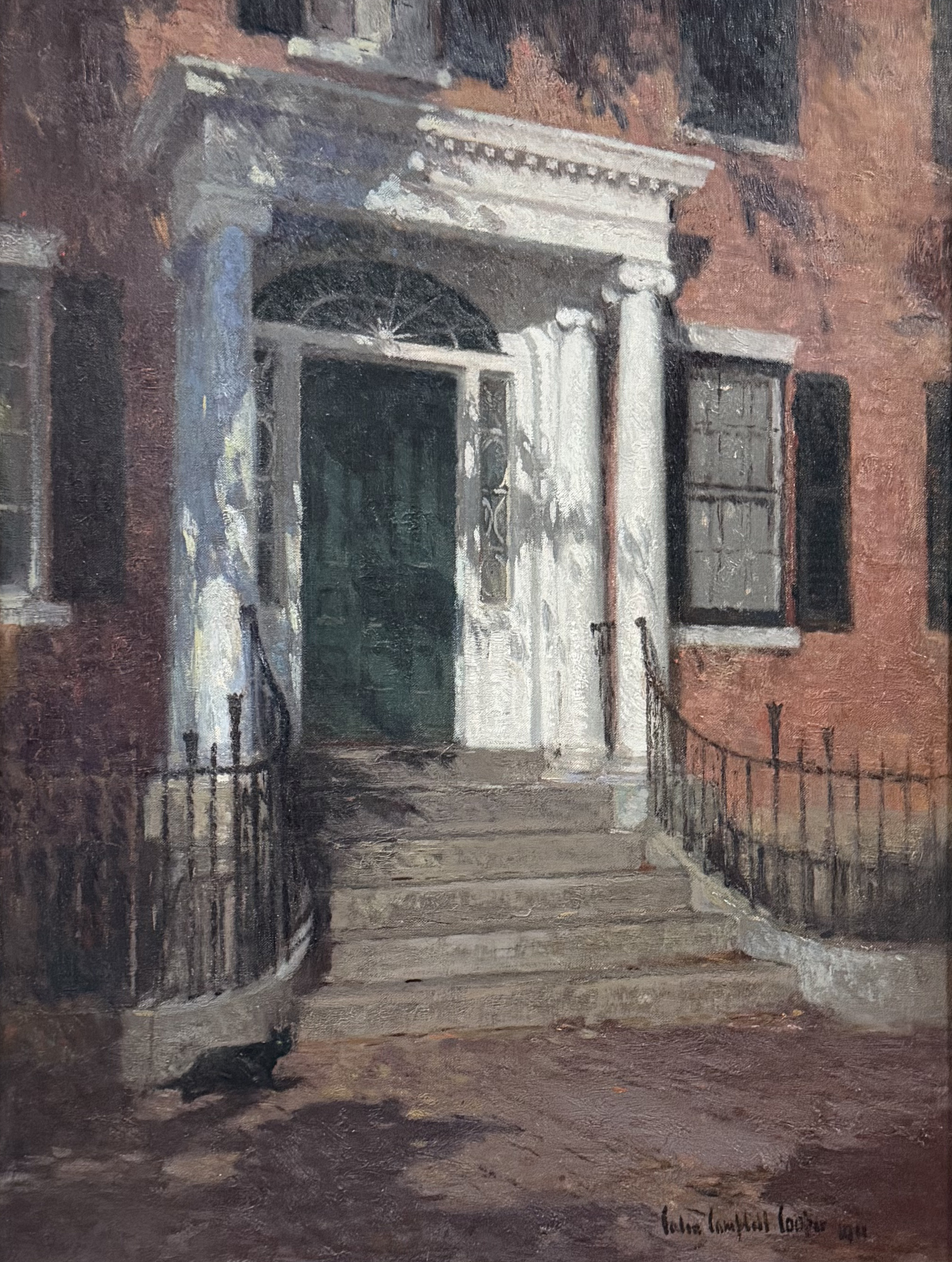
“A Salem Porch”
Colin Campbell Cooper
Oil 26″ x 20″
$36,000
See additional information about “A Salem Porch”.
Do you have a Colin Campbell Cooper painting you would like to sell? We have clients interested in adding his paintings to their collections. Call us 602-730-2451 or email us sales@artzline.com.
See it First!
Receive notifications from America's online art gallery when the latest works from top artists are available.